CBAM on Trial at the WTO
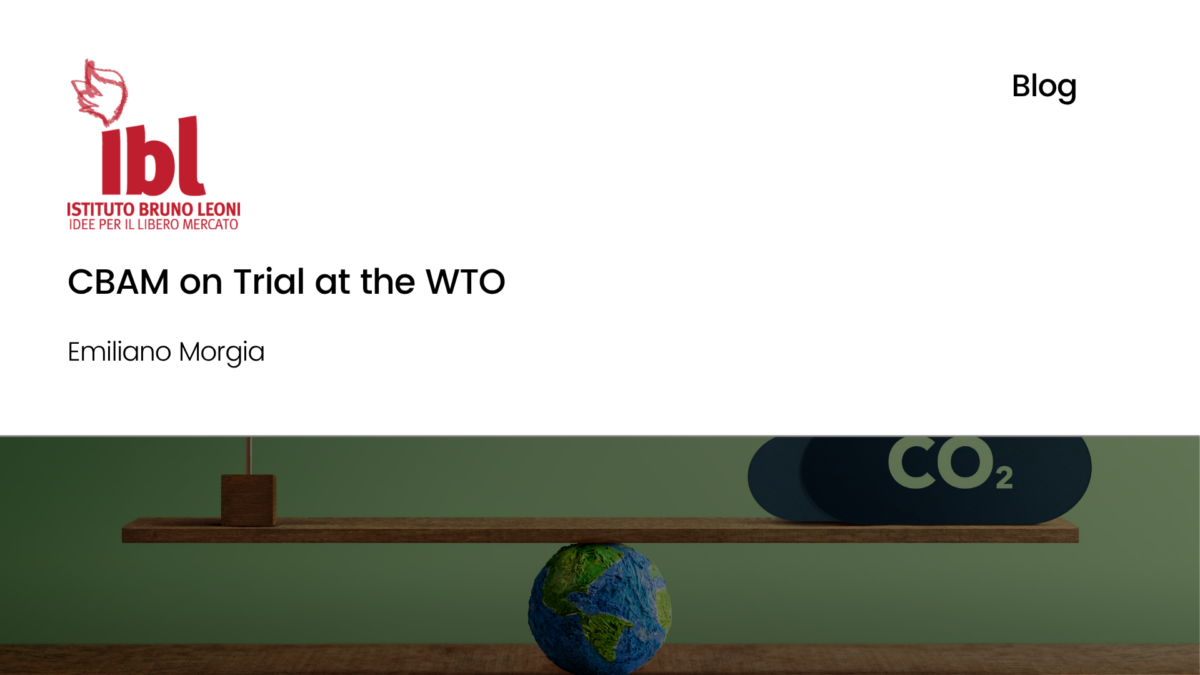
CBAM on Trial at the WTO
21 October 2026
Climate is part of the story, but the real issue is European competitiveness
On 25 September, the WTO's Dispute Settlement Body granted Russia's second request and established a panel to examine the EU’s Carbon Border Adjustment Mechanism (CBAM) and on the alleged export subsidy in the EU Emissions Trading System (ETS).
This is hardly a surprise. Moscow had formally requested consultations over CBAM and the alleged ETS export subsidy in May 2025, but the EU declined to enter into them, citing the extraordinary circumstances created by Russia’s war of aggression against Ukraine. Russia then requested the establishment of a WTO panel in July 2026. The EU objected to that first request, but WTO rules allow the respondent to block a panel request only once. When Moscow returned with a second request in September, the WTO Dispute Settlement Body established the panel. The EU reiterated the anomaly of a complaint brought by a country waging a war of aggression against another WTO member, but confirmed that it would participate in the proceedings.
To be clear, we are still a long way from a decision on the merits. Establishing a panel is a procedural step, not a finding that the measure is unlawful: next will come the composition of the panel, the written submissions, the hearings and, finally, the report.
Even so, it remains a major legal test for one of the Green Deal’s flagship policies. And not because Moscow stands a strong chance of winning, but because the dispute brings back to centre stage a question Brussels has preferred to sidestep: is the CBAM really a climate policy, or above all an industrial policy?
A common-sense idea (or is it?)
The Commission maintains that the mechanism serves to prevent carbon leakage – the shifting of emissions-intensive production to countries with laxer rules. The logic is straightforward: if a European producer pays for CO2 through the ETS, those exporting to Europe should bear a comparable cost. Put that way, it seems almost self-evident. But the most problematic public policies are often the most intuitive.
A dispute that goes beyond Russia
Moscow gives voice to a widespread discontent. India, Brazil, South Africa and China have long objected to CBAM, and in August the BRICS ministers branded it unilateral, punitive, discriminatory and protectionist. The crux is simple: when a country adds a cost to imported goods in order to align competitive conditions with those of domestic producers, the line between environmental policy and protectionism blurs.
The Union insists on the measure's climate nature; others read it as a defence of certain segments of European industry. This ambiguity is what makes the case significant. And even if the WTO were to confirm its legal compatibility, the more important question would remain: will CBAM work?
The "industrial" nature of the mechanism emerges ever more clearly in the European Commission's own choices. In December 2025, Brussels proposed a temporary €600 million fund to offset part of the higher costs the CBAM would impose on European firms. It is curious: a mechanism is introduced to correct the effects of international competition and, even before it fully takes effect, it is deemed necessary to subsidise those who will bear its consequences. In other words, we risk creating a subsidy to offset a tariff designed to offset a tax. If a policy requires such layering of correctives, it may be worth asking whether the problem lies in the original design.
More industrial policy than climate policy
As Carlo Stagnaro pointed out as early as a year ago, CBAM targets intermediate goods: steel, aluminium, cement, fertilisers, electricity and hydrogen. These are not consumer products, but the foundations of manufacturing. The aim is to shield European steelmaking from steel produced in countries with weaker environmental constraints. But what about the firms who use that steel to build turbines, machinery, cars and ships? They pay more for their inputs. It protects one link in the chain, at the risk of weakening every link downstream.
And what lies downstream is what Europe does best. In 2024 the EU posted a trade surplus of €147 billion on extra-EU exports of €2,584 billion; in the euro area, machinery and vehicles account for 39% of extra-area exports. These are the sectors that most depend on competitively priced materials and energy. The risk is to protect input producers today at the expense of finished-goods producers tomorrow.
The paradox is that Europe already had a tool designed precisely to address the risk of relocation of energy-intensive activities: free ETS allowances for sectors exposed to international competition. It was not a perfect solution, but it had an important merit. It preserved the incentive to cut emissions without distorting trade flows and without requiring the bureaucratic reconstruction of the carbon content of every imported good. As economist James Bushnell has noted, it is striking that the Union is progressively abandoning the very instrument that avoids many of the problems CBAM is now trying to solve.
The real issue is energy
For basic industries, competitiveness is first and foremost an energy issue. Steel, cement, ammonia and aluminium require enormous amounts of energy and processes that are hard to replace: this is thermodynamics, not politics. Taxing carbon does not change this reality – it changes its price. That is why CBAM risks treating the symptom rather than the cause. The problem is not only that non-European steel is cheap; it is also, and perhaps above all, that European energy is expensive.
According to IEA data, in 2025 electricity prices for the EU's energy-intensive industries remained, on average, more than double those in the United States and almost 50% above those in China. In 2019, the gap was 50% higher than in the United States and 20% higher than in China. For gas, the picture is even worse: in 2024, European wholesale prices were almost five times those in the United States, because the EU depends on imported fossil fuels while the United States is a net exporter.
This is where CBAM's structural limit becomes apparent. The mechanism does not create a single additional megawatt-hour, produce a single cubic metre of gas, or lower the price of electricity. It redistributes costs along the value chain. But industrial competitiveness comes from access to reliable, affordable energy, not customs engineering. If the energy differential persists, CBAM can soften its effects. Not eliminate them. In other words, a border barrier can partly offset a competitive disadvantage. It cannot remove its cause.
A customs duty won't close the green premium
As is often the case in technological transitions, the problem is not making existing technologies more expensive; it’s making new ones cheaper.
Whale oil did not lose the lighting market to a tax on whale oil. It lost it because, between 1850 and 1870, a fuel arrived that cost a fraction as much and, once people learned to refine it in large quantities, less still.
With steel, we are not there yet. Again, according to the IEA, the first commercial plants using hydrogen-based direct reduction and electric arc furnaces with 100% hydrogen blends currently cost between 50% and 140% more than conventional blast furnaces, depending on the region, which slows their adoption.
This "green premium" should be read honestly. The estimate includes neither a carbon price nor subsidies, and it is precisely the gap that CBAM (and the ETS) aim to close. But a border barrier makes old steel more expensive, not new steel cheaper. Reducing the premium requires investment, scale and innovation. It is no coincidence that the IEA points to structured demand – purchase commitments and offtake agreements – as the lever to make the first plants bankable: so far, demand for near-zero-emission steel has not been enough to drive production.
It is the same difference as between punishing the past and making the future affordable. CBAM, by design, does the former. That is why the dispute matters, but only up to a point.
The WTO will rule on trade law. Europe faces a more uncomfortable question: should it defend industrial competitiveness with climate tariffs, or with abundant energy, innovation, and open markets? The market will answer that one. And, as is often the case, its answer will be the one that counts.
This blog post was written by Emiliano Morgia, Quality, Health, Safety, and Environment Manager at Hatenboer-Water. To read this article in Italian, click here.
EPICENTER publications and contributions from our member think tanks are designed to promote the discussion of economic issues and the role of markets in solving economic and social problems. As with all EPICENTER publications, the views expressed here are those of the author and not EPICENTER or its member think tanks (which have no corporate view).