The Nordics are showing Europe how to grow up
The Nordics are showing Europe how to grow up
Emelie Franzén // 2 November 2026
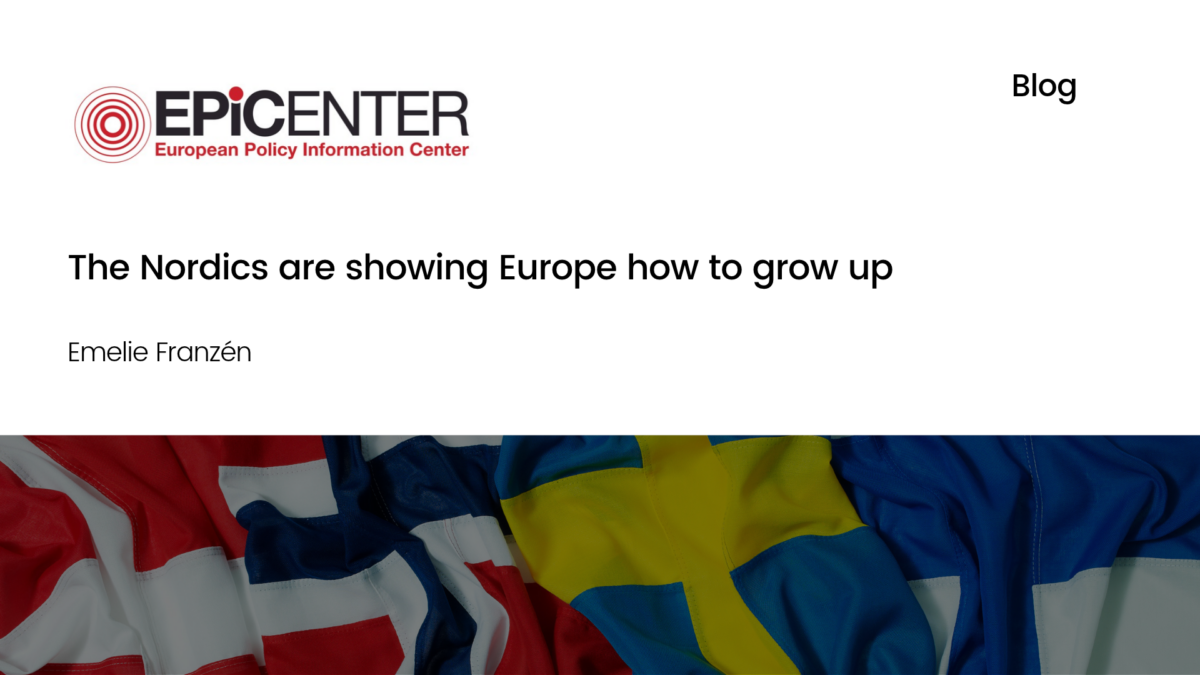
More than 10 years after the launch of Jean-Claude Juncker’s Investment Plan for Europe, it may be the private sector that finally delivers what political ambition has only promised and deferred. Nordic Compass, an industry alliance consisting of some of the Nordic countries’ foremost companies and investors, is reportedly looking into the possibility of merging the national stock exchanges of Sweden, Norway, Denmark and Finland to create a single regional marketplace – a first concrete step towards the kind of capital markets integration Europe has been debating since 2015. That this initiative comes from industry rather than government, and from a group of countries willing to move ahead without waiting for broader EU consensus, raises serious questions about where European integration is heading.
Nordic Compass launched as recently as May, chaired by former Finnish PM Jyrki Katainen and backed by some of the region’s most significant institutional investors. Its ambition is to consolidate four fragmented markets, pooling $4 trillion in pensions and sovereign assets that currently punch well below their collective weight. A concrete proposal could land as early as November. While it would require regulatory sign-off across multiple jurisdictions, the Nordics are a plausible place for a capital markets union to take shape. With mandatory funded pensions, deep retail investor participation (so-called ISK accounts) and capital markets that have consistently outperformed the European average, the Nordic countries understand better than most the role of private capital in unlocking growth. Europe’s competitiveness agenda demands the same at a far bigger scale, which no public budget, however generously funded, can substitute for. EU countries’ total assets under management reached €34.4 trillion in 2025. The problem is not a shortage of capital but that it remains fragmented, nationally siloed and largely idle.
The Capital Markets Union’s great stagnation is hardly the European Commission’s fault. Before concerns about failing the competitiveness race escalated, appetite for the necessary reforms, including harmonising withholding tax systems and ceding supervisory powers to the European Securities and Markets Authority (ESMA), was virtually non-existent among member states. Notably, there are signs that political will is shifting. In May, the E6, comprising Germany, France, Spain, Italy, Poland and the Netherlands, agreed a joint position backing stronger supervisory powers for ESMA. But other, smaller economies, such as Luxembourg and Ireland, remain incentivised to resist the kind of harmonisation that a true capital markets union would require, given the financial advantages they have built on the back of regulatory fragmentation. The countries driving the political process can agree on direction but not on the hard decisions that would actually get them there, while those making headway are doing so entirely outside the process, which tells you something about the state of European integration.
The move to consolidate regionally makes sense for a different reason. A Nordic capital markets union is attractive because it keeps integration among countries that share similar financial cultures, regulatory standards and fiscal outlooks. To this point, Swedish PM Ulf Kristersson, in a 2025 speech on capital markets, noted the importance of deeper capital integration throughout Europe but remarked that “we must not disrupt functioning markets”. This embodies a complicated relationship with European financial integration, staunchly pro-European in values and rhetoric but selective about the terms of integration – still anchored in concerns about the fiscal discipline of other EU members in light of the eurozone sovereign debt crisis and the risks further integration might expose the Swedish market to. This explains why Sweden remains outside the eurozone and why a Nordic capital markets union is much more likely to gain traction.
The question is what a Nordic capital markets union, once it becomes reality, means for a European one. Would it be a substitute or a stepping stone, akin to a ‘multi-speed’ Europe? Nordic consolidation may reduce the urgency for a European solution. It may also add another layer of fragmentation, considering in part that a non-EU country would be added to the mix, complicating an eventual path to EU-wide integration. But it may also provide a case in point for European leaders questioning feasibility, build momentum, and give Nordic countries an even stronger interest in pushing for an EU-wide solution, modelled after the Nordic market, to gain access to a larger pool. Because while a Nordic capital markets union would constitute a massive step in the right direction, it will not change the fact that European companies still have to navigate 27 different rulebooks, and it likely won’t stop them listing in New York when they want growth at scale. A genuine European capital market is the only solution that actually matches the scale of the problem. Let the Nordic model be a template for bottom-up action.
While the E6 shift suggests the political conditions are better than they have been at any point in the past decade, European integration cannot afford to wait for consensus that may never come. The window is wide open. European leaders should take note before the Nordics go it alone.
This blog post was written by Emelie Franzén, EPICENTER's Research & Content Coordinator. This article was originally published by NEGlobal. To read the original, click here.
EPICENTER publications and contributions from our member think tanks are designed to promote the discussion of economic issues and the role of markets in solving economic and social problems. As with all EPICENTER publications, the views expressed here are those of the author and not EPICENTER or its member think tanks (which have no corporate view).