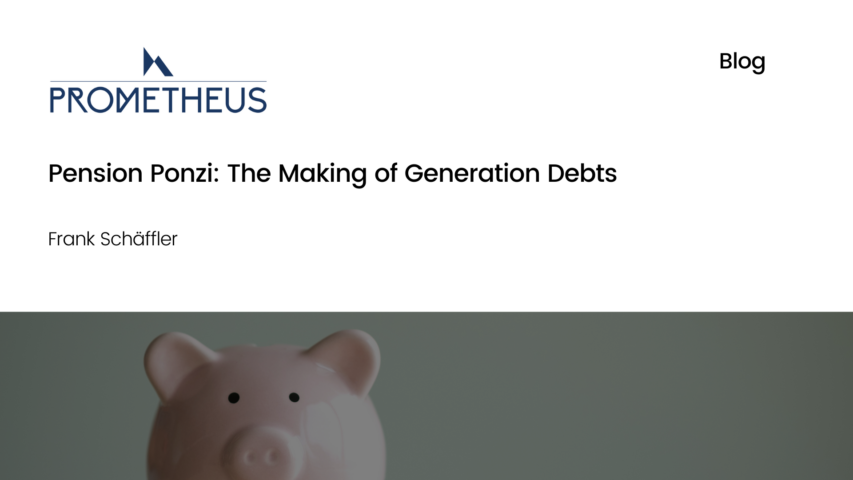
Pension Ponzi: The Making of Generation Debts
Pension Ponzi: The Making of Generation Debts
Frank Schäffler // 15 April 2026
Sometimes, late at night, an uncomfortable thought surfaces: who is actually going to pay for all of this? The growing national debt, the ever-expanding social promises, the rising federal subsidies for pensions and welfare. Every system like that is, to some degree, a bet on the future. Germany's has stopped being a bet and become a burden.
The think tank Stiftung Marktwirtschaft calculates that Germany's direct and indirect state liabilities now stand at 19.5 trillion euros. To clear this mountain of debt, every German company and every German citizen would have to work for four and a half years without pay. Germany has been living off a political illusion for years. We keep promising ourselves new benefits without honestly saying who will foot the bill in the end. The ones who are made to pay are those with no voice: our children and grandchildren. This is Generation Debts: the generation that has to pay for everything.
Germany is not an outlier. It is an example of the logic that every ageing welfare state faces. The numbers are simply further along. In the 1960s, more than six workers supported each pensioner. Today, the ratio is roughly two and a half. Within a few decades, it will barely reach two. A pay-as-you-go system living hand to mouth cannot work indefinitely. The term ‘generational contract’ sounds appealing, even solidarity-minded. Yet nobody signed it, and millions are legally required to honour it regardless. The generational contract is a generational betrayal.
If a private company ran a scheme in which new contributors were continuously needed to service the claims of existing participants, financial regulators would step in immediately and shut it down as a Ponzi scheme. In state pension policy, this same principle is defended as a social achievement.
For the younger generation, this is devastating. They are squeezed on three sides. First, they must pay growing contributions into a pension insurance system to fund existing pensions. Second, after 40 or 45 years of contributions, they can only expect a statutory pension hovering around the level of social assistance. And third, the high burden of social contributions and taxes leaves them no meaningful room for private provision. We must finally find a way out of this trilemma.
A better model would be the Swedish pension system. In the early 1990s, Sweden shifted part of its pension system to a capital-funded model. Since then, 16 percentage points of pension contributions continue to flow into a pay-as-you-go system, while 2.5 percentage points go into individual investment funds or a state fund. The latter has achieved a return of 13% per year over the past decade. The result: Sweden today spends only 7.7% of its GDP on pensions. Germany spends 10.9% and rising. At the same time, Swedish pensioners receive a pension equivalent to 65% of their last net salary. By contrast, the average statutory pension in Germany is under 1,100 euros.
Sweden shows that exit is possible. The difficulty, however, is politics: which generation can and will force the issue? The young have the most to gain and the least leverage. The old have the votes and profit from the system. As boomers, we could use our votes to change it. We owe it to Generation Debts.
Frank Schäffler served as a member of the German Parliament and is managing director of the Berlin think tank Prometheus – Heimat der Freiheit. His new book, Generation Debts: Die Generation, die alles bezahlen muss, has just been published by Langen Müller Verlag.
EPICENTER publications and contributions from our member think tanks are designed to promote the discussion of economic issues and the role of markets in solving economic and social problems. As with all EPICENTER publications, the views expressed here are those of the author and not EPICENTER or its member think tanks (which have no corporate view).