Why Iceland’s Oligarchs Triumphed Over Europe
Why Iceland’s Oligarchs Triumphed Over Europe
2 September 2026
Iceland’s rejection of the EU is the result of a campaign by the major fishing companies. Carl-Vincent Reimers travels to Reykjavik and is reminded of how important it is to have a business community that champions an open market rather than just its own commercial interests.
The roar is deafening. As the vote counts from Reykjavík’s southern constituency roll in at the ‘Yes’ election night party at the capital’s art museum, the euphoria knows no bounds. With a clear majority in favour of EU negotiations in this key constituency, hope is alive. People are toasting with beer and dancing to Loreen’s Eurovision hit ‘Euforia’. But, just like the Icelandic winter, the joy comes too soon. Soon, votes start pouring in from more EU-sceptic constituencies, and by the time that August morning reaches 8 degrees Celsius, it is clear that the ‘No’ camp has won with 52.8% of the vote.
It is a bitter defeat, not only for Iceland’s EU-supporters, but also for the union itself. Brussels had hoped that the vote would provide a boost – proof that also rich and democratically stable countries , still finds an EU membership attractive. Instead, it has proved the opposite.
But Iceland’s refusal to resume EU accession negotiations also shows how effectively the idea of a threatened national independence can be exploited in the political debate.
The desire to be independent, to be no one’s slave, is deeply rooted in Icelandic culture. In his novel Independent People (Sjálfstætt fólk)(1934–35), Nobel Prize-winner Halldór Laxness portrayed this culture of independence through the character of the farmer Bjartur, who values self-sufficiency above all else. When Iceland’s winter storms tear apart the cottages on the windswept moors, he defiantly replies ‘no’ and rebuilds them. Yet this desire to stand on one’s own two feet also makes him hostile towards all human relationships, resulting in his alienation of everything and everyone, even his own family.
Bjartur regularly crops up in the Icelandic debate on the EU and national independence – the issue that overshadowed everything else in the weeks leading up to the referendum. For some, he is the symbol of the Icelandic spirit of resistance against government, ‘papism’ and bullies. For others, he is proof of a destructive stubbornness and a ‘no’ attitude that borders on self-destruction.
One of those who falls into the latter category is Magnús Skjöld, whom I met the day before the referendum at the European Movement’s campaign office in central Reykjavik.
It is easy to see why the 58-year-old in a tweed jacket believes in European cooperation. Having studied political science in San Francisco and Cambridge, he currently holds the Jean Monnet Chair in European Security at the University of Bifröst in eastern Iceland. He has also worked for the civilian component of NATO’s occupation in Afghanistan, where he supported efforts to promote gender equality and a functioning public administration, and served a term as a member of the Althing (Iceland’s parliament) for the Social Democrats. Today, he is one of the voices in Icelandic politics who has most clearly taken a stand in favour of the EU.
“The last century has shown that sovereignty in the Westphalian sense is obsolete. To refuse to cooperation is self-defeating,” he says, adjusting his tweed jacket.
In 1989, he and Sweden’s current prime minister Ulf Kristersson (EPP) took part in the same trip to the US for young Nordic politicians. Today, he says he still believes in US military support through NATO, but emphasises that the EU has taken on a more important role in security policy in recent years.
“We saw how France and Germany stood up for Denmark when Trump threatened to take over Greenland.”
The fact that the EU has become a more important partner for Iceland is due not solely to the American threats against Greenland, which lies 300 kilometres away, but also to Iceland’s strategic importance. The island lies right in the middle of the waterway that Russian nuclear submarines must pass through to reach the Atlantic from their bases on the Kola Peninsula. Melting Arctic ice is also fuelling interest in gas and oil extraction in the region, leading to an increased presence of Russian and Chinese vessels.
As Iceland has no military defence whatsoever, the EU becomes an even more important partner when the US turns its back on the country.
“It is precisely to safeguard Iceland’s independence as a sovereign nation that we need the EU.”
Magnús and others I speak to in Reykjavik, however, point out that geopolitics played a smaller role in the Icelandic debate than in the international media coverage. Instead, it was the economy – and in particular control over the vital fishing industry – that came to take centre stage.
Someone who knows all about this is Ingvar Þóroddsson, a 28-year-old from the fishing town of Akureyri and a member of the Althing for the pro-EU Liberal Reform Party. We meet over a cup of coffee at the bustling headquarters of the ‘Yes’ campaign at the end of the day of the referendum. The premises’ large shop windows are covered with the campaign slogan ‘Já til að sjá’ (Yes to see), which refers to the EU’s offer that people want to see and take a stance on. Ingvar grew up partly in Sweden’s second largest city Gothenburg and as the August sun streams in through the shop windows, he recounts in flawless Swedish an unusually acrimonious election campaign, characterised by exaggerations and outright lies.
“The minister for foreign affairs has received death threats because she was in favour of EU negotiations. That’s not something we’re used to here. Ministers’ telephone numbers are, after all, publicly available online.”
Pro-market and pro-EU voices such as his own have found it harder to secure allies in the business community than in comparable Nordic countries. Unlike in Sweden and Denmark, the Icelandic business community is overwhelmingly opposed to EU membership and has funded large parts of the well-funded ‘no’ campaign, Áfram Ísland (Forward Iceland). Its leading figure, Halldór Benjamín Þorbergsson, was previously chairman of the Confederation of Icelandic Enterprise, the branch of Business Europe.
Opposition to the EU also extends to the Independence Party, the largest centre-right party which is an associate member of the EPP.
“I love reminding them that all their sister parties across Europe support the Union and, in many cases, the euro as well.”
The scepticism shown by the business community and the traditional right is puzzling, as the market-liberal arguments for EU membership are more relevant to Iceland than to many other economies. This concerns, above all, the single currency, the euro, which Ingvar identifies as his pet issue. The Icelandic króna is the smallest freely floating currency in the world and, since Iceland gained independence from Denmark in 1944, it has lost 99% of its value. Economists on the ‘Yes’ side argue that Iceland is too small to sustain its own currency, particularly in a time of geopolitical uncertainty when investors are turning to larger currencies.
Iceland is heavily dependent on food and fuel imports, which are becoming increasingly expensive due to the weak currency. Added to this are the EU’s agricultural tariffs, which mean that a basket of food in Iceland is 44% more expensive than the EU average. At the same time, high inflation – which in recent years has ranged between four and ten% – has created a dysfunctional credit market. Iceland is the only country in the Western world where mortgages are generally index-linked, meaning that the debt increases in line with inflation. This deters foreign investors.
So why do these facts not have an impact on the Icelandic business community?
Quite simply because of rent-seeking and companies representing their own interests, not those of the market. They are pro-business, not pro-market.
“The Icelandic banks are an oligarchy. They don’t want competition from Deutsche Bank coming here,” says Ingvar.
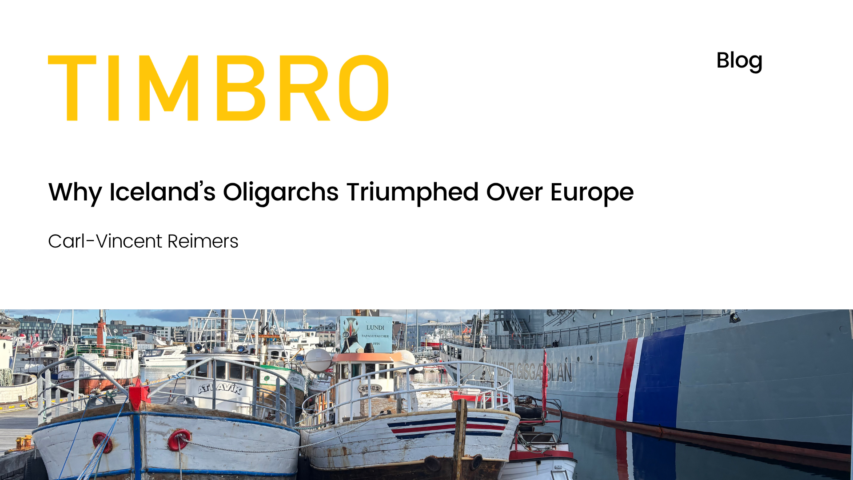
But even more important for understanding the business community’s resistance is Iceland’s most important export industry: fishing. Last year, Iceland exported fish to the EU worth 1.4 billion euros, a large sum for a country of 400 000 inhabitants. “Iceland’s oil” is controlled by a handful of large fishing companies and families who also control most of the rest of the business sector, from grocery retail to petrol stations. The fishing oligarchy has long been strongly opposed to EU accession – it is clearly not in their interest to open up their companies to foreign competition.
There is much to suggest that the Icelandic economy as a whole would have benefited from a solution in which processed fish products were also duty-free for export to the EU, rather than only fresh or frozen fish, as is the case today. However, this would also have threatened the position of the current fishing companies in Iceland.
In the campaign, opposition to the EU was cloaked in patriotic rhetoric, with arguments that EU accession would lead to Spanish and Dutch fleets buying up Iceland’s fishing quotas. It is claimed that, in the long run, this could wipe out the Icelandic fishing industry. However, one need only listen to the statements made by the EU Fisheries Commissioner, Costas Kadis, to realise that this is unlikely. On the contrary, the European Commission has signalled, unusually early on, that a national exemption is possible to ensure Icelandic control over its fishing waters.
Ingvar Þóroddsson confirms that the fishing industry has been a major financial backer of the ‘no’ campaign and has “tentacles pretty much everywhere”.
This has also shaped the debate. As early as 2009, the holding company behind Iceland’s largest daily newspaper, Morgunblaðið – which is read by 89% of Iceland’s adult population – was taken over by several major fishing companies. On the very day the referendum was announced, the newspaper received an injection of 4 million euros. A recently published investigation by the European journalism network Follow the Money shows how the fishing companies have steered the newspaper’s journalism in a strongly EU-critical direction, to the extent that outright false claims about the EU were published during the campaign.
The fishing oligarchs’ public relations efforts have also involved donations of money to several British organisations linked to Brexit and the right-wing populist UK Independence Party.
In this way, Iceland’s ‘no’ vote serves as a reminder of just how destructive the political climate can become when the business community acts as a mouthpiece for narrow corporate interests, rather than championing an open and dynamic market economy. The French liberal thinker Frédéric Bastiat once referred to this as the choice between ‘What is seen and what is not seen’ (Ce qu'on voit et ce qu'on ne voit pas) in his famous essay from 1850.
Iceland rejected the Union at a time when its negotiating position was at its strongest. The EU placed great value on welcoming a mature democracy into the Union, and by all accounts, the full scope of the EU market, democratic representation and control over its own fishing waters was within reach. Yet the fishing oligarchs told the Icelanders that they should think like Bjartur, protect what they already have and mistrust Brussels’ promises of anything else.
The losers are the narrow majority of Icelanders who said ‘yes to see’ all the other possibilities as well – those that have not yet been realised.
That is why Iceland’s ‘no’ vote is not only a loss for Iceland’s hard-fighting EU supporters, but also for liberalism.
This blog post was written by Carl-Vincent Reimers, Epicenter Research Fellow and Programme Manager for European affairs at Timbro. Timbro is the Swedish member of EPICENTER. To read this article in Swedish, click here.
EPICENTER publications and contributions from our member think tanks are designed to promote the discussion of economic issues and the role of markets in solving economic and social problems. As with all EPICENTER publications, the views expressed here are those of the author and not EPICENTER or its member think tanks (which have no corporate view).