Who Holds the Default?
Who Holds the Default?
Dr Diana Năsulea // 24 November 2026
The European Commission published its Digital Omnibus in November 2025 as a package to cut compliance costs across the EU's digital rulebook. It consolidates cybersecurity incident reporting, moves cookie rules into the GDPR, and adjusts the AI Act's timeline. It is also the first major test, in the digital field, of the Commission's pledge to reduce regulatory burdens by at least 25% for all companies and 35% for SMEs.
In this briefing, Dr Diana Năsulea (IES Europe) assesses the package against one question: does it reduce the costs firms actually bear, or does it simply move them around? Drawing on the legislative texts, the Council's negotiating positions, economic research, and national market data from France, Germany, Poland, and Romania, she finds a package that makes the rulebook more coherent but leaves most of its weight in place.
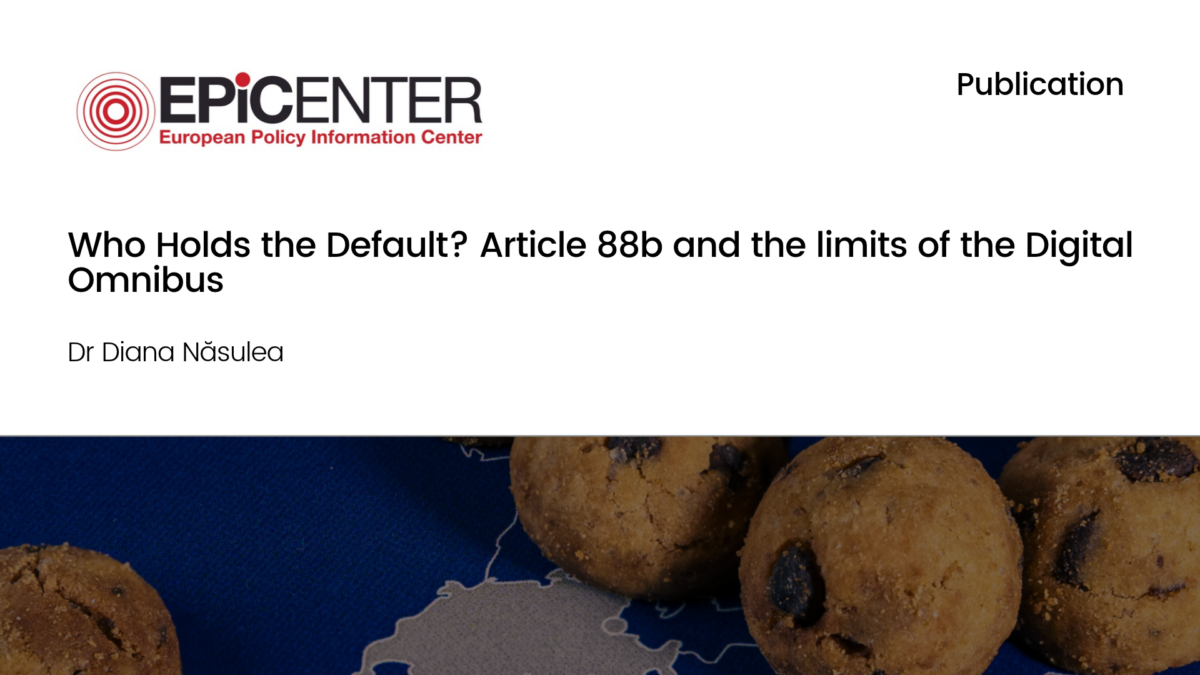
The briefing pays particular attention to proposed Article 88b, the Commission's browser-based consent signal for cookies. Presented as a simplification measure, it leaves open which way the browser setting should point, a choice that would largely decide the outcome for Europe's open web.
The main findings of the briefing include:
- A tidier rulebook, but barely a lighter one. EPICENTER's EU Regulatory Observatory scored the package 6.55 out of 10, where 5 means no change.
- Savings are counted before they are made. The Commission's €800 million a year saving from the cookie reform covers administrative costs only, not the advertising revenue at stake.
- The AI Act delay exposes a design problem. High-risk obligations were postponed because the standards needed for compliance were not ready, and the new deadlines are fixed dates too.
- Article 88b leaves the default to browser vendors. A Google-commissioned study estimates 30–35% of European advertiser revenue could be at risk, with smaller publishers likely hit hardest.
- The file is still open. The Council deleted Article 88b in October 2026, but Parliament will not settle its position before 2027.
Download or share this publication
View the PDF
EPICENTER publications and contributions from our member think tanks are designed to promote the discussion of economic issues and the role of markets in solving economic and social problems. As with all EPICENTER publications, the views expressed here are those of the author and not EPICENTER or its member think tanks (which have no corporate view).